Problems in Projective Geometry
The following list of problems is aimed to those who want to practice projective geometry. They cover topics such as cross ration, harmonic conjugates, poles and polars, and theorems of Desargue, Pappus, Pascal, Brianchon, and Brocard.
Problem 1
Given a quadrilateral \(ABCD\), let
\(P=AB\cap CD\), \(Q=AD\cap BC\), \(R=AC\cap PQ\), \(S=BD\cap PQ\).
Prove that \(\mathcal H(P,Q;R,S)\).
Let \(T=AC\cap BD\).
Consider the sequence of the perspectivities
\[PQRS\frac{A}{\overline\wedge} BDTS\frac{C}{\overline\wedge} QPRS.\]
Since the perspectivity preserves the cross-ratio
\(\mathcal R(P,Q;R,S)=\mathcal R(Q,P;R,S)\) we obtain that \(\mathcal H(P,Q;R,S)\).
Problem 2
Given a triangle \(ABC\) and a point \(M\) on \(BC\), let
\(N\) be the point of the line \(BC\) such that
\(\angle MAN=90^{\circ}\). Prove that \(\mathcal H(B,C;M,N)\)
if and only if \(AM\) is the bisector of the angle
\(\angle BAC\).
Let \(\alpha=\angle BAC\), \(\beta=\angle CBA\),
\(\gamma=\angle ACB\) and \(\varphi=\angle BAM\).
Using the sine theorem on
\(\triangle ABM\) and \(\triangle ACM\) we get
\[\frac{BM}{MC}=\frac{BM}{AM}\frac{AM}{CM}=
\frac{\sin\varphi}{\sin\beta}\,\frac{\sin\gamma}{\sin(\alpha-
\varphi)}.\]
Similarly using the sine theorem on \(\triangle ABN\) and
\(\triangle ACN\) we get
\[\frac{BN}{NC}=\frac{BN}{AN}\frac{AN}{CN}=
\frac{\sin(90^\circ-\varphi)}{\sin(180^\circ-\beta)}\,
\frac{\sin\gamma}{\sin(90^\circ+\alpha-\varphi)}.\]
Combining the previous two equations
we get
\[\frac{BM}{MC}:\frac{BN}{NC}=\frac{\tan\varphi}{\tan(\alpha-
\varphi)}.\]
Hence, \(|\mathcal R(B,C;M,N)|=1\) is equivalent to
\(\tan\varphi=\tan(\alpha-\varphi)\), i.e.
to \(\varphi=\alpha/2\). Since \(B\neq C\) and
\(M\neq N\), the relation \(|\mathcal R(B,C;M,N)|=1\)
is equivalent to
\(\mathcal R(B,C;M,N)=-1\), and the statement is now shown.
Problem 3
Let \(A\) and \(B\) be two points and
let \(C\) be the point of the line
\(AB\). Using just a ruler find a point
\(D\) on the line \(AB\)
such that \(\mathcal H(A,B;C,D)\).
The motivation is the problem 1.
Choose a point \(K\) outside \(AB\) and point \(L\)
on \(AK\) different from \(A\) and \(K\).
Let \(M=BL\cap CK\) and \(N=BK\cap AM\).
Now let us construct a point \(D\) as \(D=AB\cap LN\).
From the problem 1 we indeed have \(\mathcal H(A,B;C,D)\).
Problem 4
Let \(A\), \(B\), \(C\) be the diagonal points
of the quadrilateral \(PQRS\), or equivalently
\(A=PQ\cap RS\), \(B=QR\cap SP\), \(C=PR\cap QS\).
If only the points \(A\), \(B\), \(C\), \(S\), are given
using just a ruler construct the points
\(P\), \(Q\), \(R\).
Let us denote \(D=AS\cap BC\).
According to the problem 1 we have \(\mathcal H(R,S;A,D)\).
Now we construct the point
\(D=AS\cap BC\). We have the points \(A\), \(D\), and \(S\),
hence according to the previous problem we can construct
a point \(R\) such that \(\mathcal H(A,D;S,R)\).
Now we construct \(P=BS\cap CR\) and \(Q=CS\cap BR\),
which solves the problem.
Problem 5
Assume that the incircle of \(\triangle ABC\)
touches the sides \(BC\), \(AC\), and \(AB\)
at \(D\), \(E\), and \(F\).
Let \(M\) be the point such that the circle
\(k_1\) incscribed in \(\triangle BCM\) touches \(BC\)
at \(D\), and the sides \(BM\) and \(CM\)
at \(P\) and \(Q\).
Prove that the lines \(EF\), \(PQ\), \(BC\) are concurrent.
It is well known (and is easy to prove using
Ceva's theorem) that the lines \(AD\), \(BE\), and \(CF\)
intersect at a point \(G\)
(called a Gergonne point of \(\triangle ABC\))
Let \(X=BC\cap EF\). As in the problem 1 we have \(\mathcal H(B,C;D,X)\).
If we denote \(X\prime =BC\cap PQ\) we analogously have \(\mathcal H(B,C;D,X\prime )\),
hence \(X=X\prime \).
Problem 6
Given a triangle \(ABC\), let \(D\) and \(E\) be the points
on \(BC\) such that \(BD=DE=EC\).
The line \(p\) intersects \(AB\), \(AD\), \(AE\), \(AC\) at
\(K\), \(L\), \(M\), \(N\), respectively.
Prove that \(KN\geq 3 LM\).
Let us denote \(x=KL\), \(y=LM\), \(z=MN\).
We have to prove that \(x+y+z\ge 3y\), or equivalently
\(x+z\ge 2y\). Since \(\mathcal R(K,N;L,M)=\mathcal R(B,C;D,E)\),
we have \[\frac x{y+z}:\frac{x+y}z=
\frac{\overrightarrow{KL}}{\overrightarrow{LN}}:\frac{\overrightarrow{KM}}{\overrightarrow{MN}}=
\frac{\overrightarrow{BD}}{\overrightarrow{DC}}:\frac{\overrightarrow{BE}}{\overrightarrow{EC}}=
\frac 12\cdot\frac 12,\]
implying \(4xz=(x+y)(y+z)\).
If it were \(y > (x+z)/2\) we would have
\[x+y > \frac 32 x+\frac 12 z=2\frac 14(x+x+x+z)\ge
2 \sqrt[4]{xxxz},\] and analogously \(y+z > 2\sqrt[4]{xzzz}\)
as well as \((x+y)(y+z) > 4xz\) which is a contradiction. Hence
the assumption \(y > (x+z)/2\) was false so we have
\(y\le (x+z)/2\).
Let us analyze the case of equality. If \(y=(x+z)/2\),
then \(4xz=(x+y)(x+z)=(3x+z)(x+3z)/4\),
which is equivalent to \((x-z)^2=0\).
Hence the equality holds if \(x=y=z\).
We leave to the reader to prove that \(x=y=z\)
is satisfied if and only if \(p\parallel BC\).
Problem 7
The point \(M_1\) belongs to the side \(AB\) of the quadrilateral
\(ABCD\). Let \(M_2\) be the projection of \(M_1\) to the line
\(BC\) from \(D\), \(M_3\) projection of \(M_2\) to \(CD\) from \(A\),
\(M_4\) projection of \(M_3\) to \(DA\) from \(B\), \(M_5\) projection
of \(M_4\) to \(AB\) from \(C\), etc. Prove that \(M_{13}=M_1\).
Let \(E=AB\cap CD\), \(F=AD\cap BC\).
Consider the sequence of perspectivities
\[
ABEM_1\frac{D}{\overline\wedge}FBCM_2\frac{A}{\overline\wedge}DECM_3\frac{B}{\overline\wedge}
DAFM_4\frac{C}{\overline\wedge}EABM_5. \quad\quad\quad\quad\quad (1)\] According to the conditions given
in the problem this
sequence of perspectivities has two be applied three more
times
to arrive to the point \(M_{13}\).
Notice that the given sequence of perspectivities
maps \(A\) to \(E\), \(E\) to \(B\), and \(B\) to \(A\).
Clearly if we apply (1) three times
the points \(A\), \(B\), and \(E\) will be fixed
while \(M_1\) will be mapped to \(M_{13}\).
Thus \(M_1=M_{13}\).
Problem 8 (Butterfly Theorem)
Points \(M\) and \(N\) belong to the circle \(k\).
Let \(P\) be the midpoint of the chord
\(MN\), and let \(AB\) and \(CD\) (\(A\) and \(C\) are
on the same side of
\(MN\)) be arbitrary chords of \(k\)
passing through \(P\). Prove that lines \(AD\) and \(BC\)
intersect \(MN\) at points that are equidistant
from \(P\).
Let \(X\prime \)
be the point symmetric to \(Y\) with respect to \(P\).
Notice that
\[
\mathcal R(M,N;X,P) = \mathcal R(M,N;P,Y)\quad\mbox{(from }
MNXP\frac{D}{\overline\wedge}MNAC\frac{B}{\overline\wedge}MNPY) \]
\[ = \mathcal R(N,M;P,X\prime )\quad\mbox{(
the reflection with the center }P\mbox{ preserves}\]
\[ \qquad\qquad\qquad\quad\mbox{the ratio,
hence it preserves the cross-ratio)} \]
\[ = \frac{1}{\mathcal R(N,M;X\prime ,P)}=\mathcal R(M,N;X\prime ,P),
\]
where the last equality follows from the basic properties
of the cross ratio. It follows that
\(X=X\prime \).
Problem 9
Given a triangle \(ABC\), let \(D\) and \(E\) be the points
of the sides \(AB\) and \(AC\) respectively such that
\(DE\| BC\). Let \(P\) be an interior point of the triangle
\(ADE\). Assume that the lines \(BP\) and \(CP\) intersect \(DE\)
at \(F\) and \(G\) respectively.
The circumcircles of \(\triangle PDG\) and \(\triangle PFE\)
intersect at \(P\) and \(Q\). Prove that the points \(A\), \(P\), and
\(Q\) are collinear.
Let \(J=DQ\cap BP\), \(K=EQ\cap CP\).
If we prove that \(JK\parallel DE\)
this would imply that the triangles
\(BDJ\) and \(CEK\) are perspective with the respect to a
center, hence with repsect to an axis as well (according to
Desargue's theorem) which immediately implies that
\(A\), \(P\), \(Q\) are colinear
(we encourage the reader to verify this fact).
Now we will prove that \(JK\|DE\).
Let us denote \(T=DE\cap PQ\). Applying the Menelaus theorem
on the triangle \(DTQ\) and the line \(PF\) we get
\[\frac{\overrightarrow{DJ}}{\overrightarrow{JQ}}\frac{\overrightarrow{QP}}{\overrightarrow{PT}}\frac{
\overrightarrow{TF}}{\overrightarrow{FD}}=-1.\]
Similarly from the triangle \(ETQ\) and the line \(PG\):
\[\frac{\overrightarrow{EK}}{\overrightarrow{KQ}}\frac{\overrightarrow{QP}}{\overrightarrow{PT}}
\frac{\overrightarrow{TG}}{\overrightarrow{GE}}=-1.\]
Dividing the last two equalities and using
\(DT\cdot TG=FT\cdot TE\) (\(T\) is on the radical axis
of the circumcircles of \(\triangle DPG\) and \(\triangle FPE\)),
we get
\[\frac{\overrightarrow{DJ}}{\overrightarrow{JQ}}=\frac{\overrightarrow{EK}}{\overrightarrow{KQ}}.\]
Thus \(JK\parallel DE\), q.e.d.
Problem 10 (IMO 1997 shortlist)
Let \(A_1A_2A_3\) be a non-isosceles
triangle with the incenter \(I\).
Let \(C_i\), \(i=1\), \(2\), \(3\), be the smaller circle through
\(I\) tangent to both \(A_iA_{i+1}\) and \(A_iA_{i+2}\)
(summation of indeces is done modulus 3).
Let \(B_i\), \(i=1\), \(2\), \(3\), be the other intersection point
of \(C_{i+1}\) and \(C_{i+2}\). Prove that the circumcenters
of the triangles \(A_1B_1I\), \(A_2B_2I\), \(A_3B_3I\) are collinear.
Apply the inversion with the respect to \(I\).
We leave to the reader to draw the inverse picture.
Notice that the condition that \(I\) is the incentar now reads
that the circumcircles
\(A_i^*A_{i+1}^*I\) are of the same radii. Indeed if \(R\) is
the radius of the circle of inversion and \(r\) the distance
between \(I\) and \(XY\)
then the radius of the circumcircle of \(\triangle IX^*Y^*\)
is equal to \(R^2/r\).
Now we use the following statement that is very easy to prove:
``Let \(k_1\), \(k_2\), \(k_3\) be three circles such that
all pass through the
same point \(I\), but no two of them are mutually tangent. Then
the centers of these circles are colinear if and only if there
exists another common point \(J\neq I\)
of these three circles.\(\prime\prime\)
In the inverse picture this transforms into proving that
the lines \(A_1^*B_1^*\), \(A_2^*B_2^*\), and \(A_3^*B_3^*\)
intersect at a point.
In order to prove this it is enough to show that the corresponding
sides of the triangles \(A_1^*A_2^*A_3^*\) and \(B_1^*B_2^*B_3^*\)
are parallel (then these triangles would be perspective with
respect to the infinitely far line). Afterwards the
Desargue's theorem would imply
that the triangles are perspective with respect to a center.
Let \(P_i^*\) be the incenter of \(A_{i+1}^*A_{i+2}^*I\),
and let \(Q_i^*\) be the foot of the perpendicular
from \(I\) to \(P_{i+1}^*P_{i+2}^*\).
It is easy to prove that
\[\overrightarrow{A_1^*A_2^*}=
2\overrightarrow{Q_1^*Q_2^*}=
-\overrightarrow{P_1^*P_2^*}.\]
Also since the circles
\(A_i^*A_{i+1}^*I\) are of the same radii,
we have \(P_1^*P_2^*\parallel B_1^*B_2^*\), hence
\(A_1^*A_2^*\parallel B_1^*B_2^*\).
Problem 11
Given a triangle \(ABC\) and a point \(T\), let \(P\) and
\(Q\) be the feet of perpendiculars from
\(T\) to the lines \(AB\) and \(AC\), respectively. Let
\(R\) and \(S\) be the feet of perpendiculars
from \(A\) to \(TC\) and \(TB\), respectively.
Prove that the intersection of \(PR\) and \(QS\)
belongs to \(BC\).
We will prove that the intersection \(X\) of \(PR\) and \(QS\)
lies on the line \(BC\). Notice that the points
\(P\), \(Q\), \(R\), \(S\) belong to the circle with center \(AT\).
Consider the six points \(A\), \(S\), \(R\), \(T\), \(P\), \(Q\) that lie
on a circle.
Using Pascal's theorem with respect to the diagram
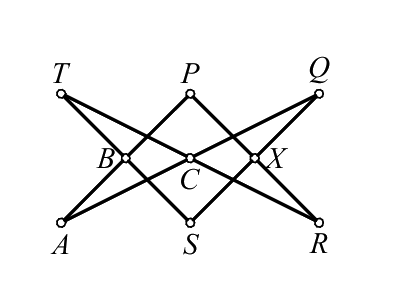
we get that the points \(B\), \(C\), and \(X=PR\cap QS\)
are collinear.
Problem 12
Given a triangle \(ABC\) and a point \(M\), a line
passing through \(M\) intersects
\(AB\), \(BC\), and \(CA\)
at
\(C_1\), \(A_1\), and \(B_1\), respectively.
The lines \(AM\), \(BM\), and \(CM\) intersect the circumcircle of
\(\triangle ABC\) repsectively at \(A_2\), \(B_2\), and \(C_2\).
Prove that the lines \(A_1A_2\), \(B_1B_2\), and \(C_1C_2\)
intersect in a point that belongs
to the circumcircle of \(\triangle ABC\).
First solution,
using projective mappings. Let \(A_3=AM\cap BC\) and
\(B_3=BM\cap AC\). Let \(X\) be the other intersection point
of the line \(A_1A_2\) with the circumcircle \(k\) of \(\triangle
ABC\). Let \(X\prime \) be the other intersection point
of the line
\(B_1B_2\) with \(k\). Consider the sequence of perspectivities
\[ABCX\frac{A_2}{\overline\wedge}A_3BCA_1\frac{M}{\overline\wedge}AB_3CB_1\frac{B_2}{\overline\wedge}ABCX\prime \]
which has three fixed points \(A\), \(B\), \(C\),
hence \(X=X\prime \). Analogously the line
\(C_1C_2\) contains \(X\) and the problem is completely solved.
Second solution, using Pascal's theorem.
Assume that the line \(A_1A_2\)
intersect the circumcircle of the triangle \(ABC\)
at \(A_2\) and \(X\).
Let \(XB_2\cap AC=B_1\prime \). Let us apply the Pascal's theorem on
the points \(A\), \(B\), \(C\), \(A_2\), \(B_2\), \(X\) according
the diagram:
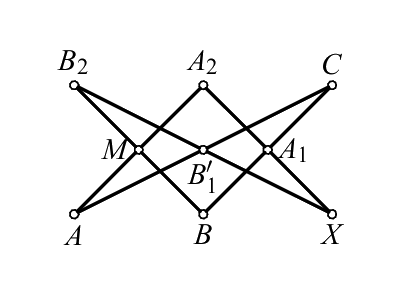
\end{center} It follows that the points
\(A_1\), \(B_1\prime \), and \(M\) are colinear. Hence
\(B_1\prime \in A_1M\). According to the definition of the point
\(B_1\prime \) we have \(B_1\prime \in AC\) hence \(B_1\prime =A_1M\cap AC=B_1\).
The conclusion is that the points \(X\), \(B_1\), \(B_2\) are colinear.
Analogously we prove that the points
\(X\), \(C_1\), \(C_2\) are colinear, hence the lines
\(A_1A_2\), \(B_1B_2\), \(C_1C_2\) intersect at
\(X\) that belongs to the circumcircle of the triangle
\(ABC\).
Problem 13
Let \(P\) and \(Q\)
isogonaly conjugated points and assume that
\(\triangle P_1P_2P_3\) and \(\triangle Q_1Q_2Q_3\)
are their pedal triangles, respectively.
It is well known
(from the theory of pedal triangles)
that pedal triangles corresponding to the isogonally conjugated
points have the common circumcircle, so called {\em pedal
circle} of the points \(P\) and \(Q\). The center of that
circle which is at the same time the midpoint of \(PQ\)
will be denoted by \(R\). Let \(P_1\prime =PP_1\cap Q_1R\) and
\(P_2\prime =PP_2\cap Q_2R\) (the points \(P_1\prime \) and \(P_2\prime \)
belong to the pedal circle of the point \(P\),
as point on the same diameters as \(Q_1\) and \(Q_2\)
respectively). Using the Pascal's theorem on the points
\(Q_1\), \(P_2\), \(P_2\prime \), \(Q_2\), \(P_1\), \(P_1\prime \) in the order shown
by the diagram
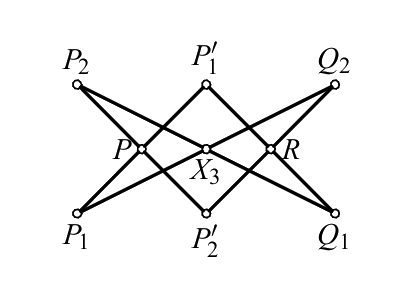
we get that the points \(P\), \(R\), \(X_1\) are colinear or
\(X_1\in PQ\). Analogously the points \(X_2\), \(X_3\)
belong to the line \(PQ\).
Problem 14
If the points \(A\) and \(M\)
are conjugated with respect to \(k\),
then the circle with diameter \(AM\)
is orthogonal to \(k\).
Let us recall the statement according to which the circle
\(l\) is invariant under the inversion with respect to the
circle \(k\) if and only if \(l=k\) or \(l\perp k\).
Since the point \(M\) belongs to the polar of the point
\(A\) with respect to \(k\) we have
\(\angle MA^*A=90^\circ\) where \(A^*=\psi_l(A)\).
Therefore \(A^*\in l\) where \(l\) is the circle with the
radius \(AM\). Analogously \(M^*\in l\). However from
\(A\in l\) we get \(A^*\in l^*\); \(A^*\in l\) yields
\(A\in l^*\) (the inversion is inverse to itself)
hence \(\psi_l(A^*)=A\)). Similarly we get \(M\in l^*\)
and \(M^*\in l^*\). Notice that the circles \(l\) and \(l^*\)
have the four common points \(A\), \(A^*\), \(M\), \(M^*\), which
is exactly two too much.
Hence \(l=l^*\) and according to the
statement mentioned at the beginning we conclude
\(l=k\) or \(l\perp k\). The case \(l=k\)
can be easily eliminated, because the circle \(l\)
has the diameter \(AM\), and \(AM\) can't be the diameter of
\(k\) because \(A\) and \(M\) are conjugated to each other.
Thus \(l\perp k\), q.e.d.
Problem 15
From a point \(A\) in the exterior of a circle
\(k\) two tangents \(AM\) and \(AN\) are drawn. Assume that
\(K\) and \(L\) are two points of \(k\) such that
\(A, K, L\) are colinear.
Prove that \(MN\) bisects the segment \(PQ\).
Let \(J=KL\cap MN\), \(R=l\cap MN\), \(X_\infty=l\cap AM\).
Since \(MN\) is the polar of \(A\) from \(J\in MN\) we get
\(\mathcal H(K,L;J,A)\). From \(KLJA\frac{M}{\overline\wedge}PQRX_\infty\) we also have
\(\mathcal H(P,Q;R,X_\infty)\). This implies that \(R\) is the midpoint
of
\(PQ\).
Problem 16
The point isogonaly conjugated to the centroid is called
the Lemuan point. The lines
connected the vertices
with the Lemuan point are called symmedians. Assume
that the tangents from \(B\) and \(C\) to the circumcircle
\(\Gamma\) of \(\triangle ABC\) intersect at the point
\(P\). Prove that \(AP\) is a symmedian of \(\triangle ABC\).
Let \(Q\) be the intersection point of the lines
\(AP\) and \(BC\). Let \(Q\prime \) be the point of \(BC\)
such that the ray \(AQ\prime \) is isogonal
to the ray \(AQ\) in the triangle \(ABC\).
This exactly
means that \(\angle Q\prime AC=\angle BAQ\) i \(\angle BAQ\prime =\angle QAC\).
For an arbitrary point \(X\) of the segment \(BC\),
the sine theorem applied to triangles
\(BAX\) and \(XAC\) yields
\[\frac{BX}{XC}=\frac{BX}{AX} \frac{AX}{XC}=
\frac{\sin\angle BAX}{\sin\angle ABX} \frac{\sin\angle
ACX}{\sin\angle XAC}= \frac{\sin\angle ACX}{\sin\angle ABX}
\frac{\sin\angle BAX}{\sin\angle XAC}=\frac{AB}{AC}
\frac{\sin\angle BAX}{\sin\angle XAC}.\]
Applying this to \(X=Q\) and \(X=Q\prime \)
and multiplying together afterwards we get
\[\frac{BQ}{QC} \frac{BQ\prime }{Q\prime C}=\frac{AB}{AC}
\frac{\sin\angle BAQ}{\sin\angle QAC} \frac{AB}{AC}
\frac{\sin\angle BAQ\prime }{\sin\angle Q\prime AC} = \frac{AB^2}{AC^2}.
\quad\quad\quad\quad\quad (1)\]
Hence if we prove \(BQ/QC=AB^2/AC^2\)
we would immediately have \(BQ\prime /Q\prime C=1\), making \(Q\prime \) the midpoint
of \(BC\). Then the line \(AQ\)
is isogonaly conjugated to the median,
implying the required statement.
Since \(P\)
belongs to the polars of \(B\) and \(C\),
then the points \(B\) and \(C\)
belong to the polar of the point
\(P\), and we conclude that the polar of \(P\)
is precisely \(BC\).
Consider the intersection \(D\) of the line \(BC\) with the
tangent to the circumcircle at \(A\).
Since the point \(D\) belongs to the polars
of \(A\) and \(P\), \(AP\) has to be
the polar of \(D\). Hence \(\mathcal H(B,C;D,Q)\).
Let us now calculate the ratio \(BD/DC\). Since the triangles
\(ABD\) and \(CAD\) are similar we have
\(BD/AD=AD/CD=AB/AC\). This implies
\(BD/CD=(BD/AD) (AD/CD)=AB^2/AC^2\).
The relation \(\mathcal H(B,C;D,Q)\) implies \(BQ/QC=BD/DC=AB^2/AC^2\),
which proves the statement.
Problem 17
Given a triangle \(ABC\), assume that the incircle
touches the sides \(BC\), \(CA\), \(AB\) at the points
\(M\), \(N\), \(P\), respectively. Prove that \(AM\), \(BN\), and
\(CP\) intersect in a point.
The statement follows from the Brianchon's theorem
applied to \(APBMCN\).
Problem 18
Let \(ABCD\) be a quadrilateral circumscribed about a
circle. Let \(M\), \(N\), \(P\), and \(Q\) be the points of tangency
of the incircle with the sides
\(AB\), \(BC\), \(CD\), and \(DA\) respectively.
Prove that the lines \(AC\), \(BD\), \(MP\), and \(NQ\)
intersect in a point.
Applying the Brianchon's theorem
to the hexagon
\(AMBCPD\) we get that the line \(MP\)
contains the intersection of \(AB\) and \(CD\). Analogously,
applying the Brianchon's theorem to \(ABNCDQ\)
we get that \(NQ\) contains the same point.
Problem 19
Let \(ABCD\) be a cyclic quadrilateral
whose diagonals \(AC\) and \(BD\)
intersect at \(O\); extensions of the sides \(AB\) and \(CD\)
at \(E\); the tangents to the circumcircle
from \(A\) and \(D\) at \(K\); and the tangents to the circumcircle
at \(B\) and \(C\) at \(L\). Prove that the points \(E\), \(K\), \(O\), and
\(L\) lie on a line.
The Brokard's theorem claims that the polar of
\(F=AD\cap BC\) is the line \(f=EO\).
Since the polar of the point on the circle is equal to the
tangent at that point we know that
\(K=a\cap d\), where \(a\) and \(d\) are polars of the points \(A\)
and \(D\). Thus \(k=AD\). Since \(F\in AD=k\), we have \(K\in f\)
as well. Analogously we can prove that
\(L\in f\), hence the points \(E\), \(O\), \(K\), \(L\)
all belong to \(f\).
Problem 20
Let \(ABCD\) be a cyclic quadrilateral.
The lines \(AB\) and \(CD\) intersect at the point
\(E\), and the diagonals \(AC\) and \(BD\) at the point \(F\).
The circumcircle of the triangles
\(\triangle AFD\) and \(\triangle BFC\)
intersect again at \(H\). Prove that \(\angle EHF=90^{\circ}\).
Let \(G=AD\cap BC\).
Let \(k\) be the circumcircle of \(ABCD\).
Denote by \(k_1\) and \(k_2\) respectively the circumcircles
of \(\triangle ADF\) and \(\triangle BCF\).
Notice that \(AD\) is the radical axis of the circles
\(k\) and \(k_1\); \(BC\) the radical axis of
\(k\) and \(k_2\); and \(FH\) the radical axis of \(k_1\) and
\(k_2\). According to the famous theorem
these three radical axes intersect at one point \(G\).
In other words we have shown that the points \(F\),
\(G\), \(H\) are colinear.
Without loss of generality assume that \(F\) is between
\(G\) and \(H\) (alternatively, we could use the
oriented angles). Using the inscribed quadrilaterals \(ADFH\)
and \(BCFH\), we get \(\angle DHF=
\angle DAF=\angle DAC\) and \(\angle FHC=\angle FBC=\angle DBC\),
hence \(\angle DHC=\angle DHF+\angle FHC=\angle DAC +\angle
DBC=2\angle DAC=\angle DOC\). Thus the points \(D\), \(C\), \(H\), and
\(O\) lie on a circle. Similarly we prove that
the points \(A\), \(B\),
\(H\), \(O\) lie on a circle.
Denote by \(k_3\) and \(k_4\) respectively the circles
circumscribed about the quadrilaterals
\(ABHO\) and \(DCHO\). Notice that the line \(AB\)
is the radical axis of the
circles \(k\) and \(k_3\). Simlarly \(CD\) and \(OH\), respectively,
are those of the pairs of circles
\((k,k_2)\) and \((k_3,k_4)\).
Thus these lines have to intersect at one point, and that
has to be \(E\). This proves that the points
\(O\), \(H\), and \(E\) are colinear.
According to the Brocard's theorem we have
\(FH\bot OE\), which according to \(FH=GH\) and
\(OE=HE\) in turn implies that \(GH\bot HE\), q.e.d.