MTH2205 Home
MTH 2205: Final Practice 1 (Part 2: Calculators are allowed)
Problem 1. The position function of a particle is given by \(s=t^3-1.5t^2-2t\), for \(t\geq 0\). At what value of \(t\) does the particle reach a velocity of \(166\) m/sec?
(A) \(t=7\) sec \(\quad\quad\) (B) \(t=8\) sec \(\quad\quad\) (C) \(t=5\) sec \(\quad\quad\) (D) \(t=3\) sec \(\quad\quad\) (E) \(t=12\) sec
(A) \(t=7\) sec \(\quad\quad\) (B) \(t=8\) sec \(\quad\quad\) (C) \(t=5\) sec \(\quad\quad\) (D) \(t=3\) sec \(\quad\quad\) (E) \(t=12\) sec
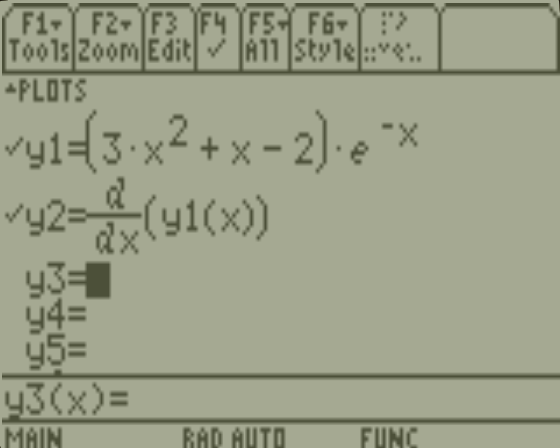
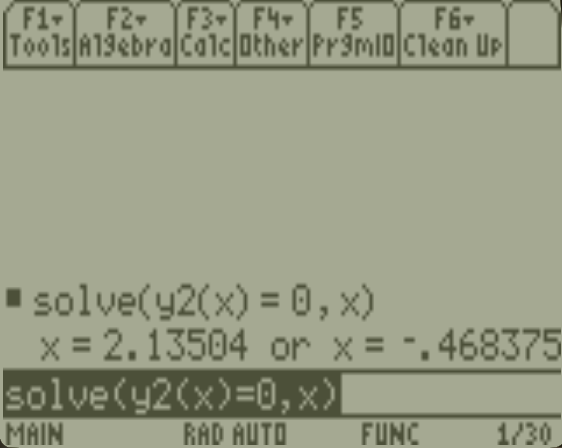
Problem 2. The function \(y=\frac{3x^2+x-2}{e^x}\) has a horizontal tangent line when:
(A) \(x=-3\) and \(x=1.125\) \(\quad\quad\) (B) \(x=-0.468\) and \(x=2.135\) \(\quad\quad\) (C) \(x=-1\) and \(x=0.667\)
(D) \(x=-0.415\) and \(x=2.278\) \(\quad\quad\) (E) Never
(A) \(x=-3\) and \(x=1.125\) \(\quad\quad\) (B) \(x=-0.468\) and \(x=2.135\) \(\quad\quad\) (C) \(x=-1\) and \(x=0.667\)
(D) \(x=-0.415\) and \(x=2.278\) \(\quad\quad\) (E) Never
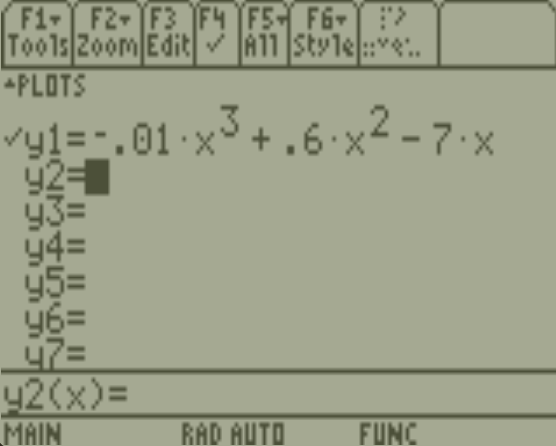
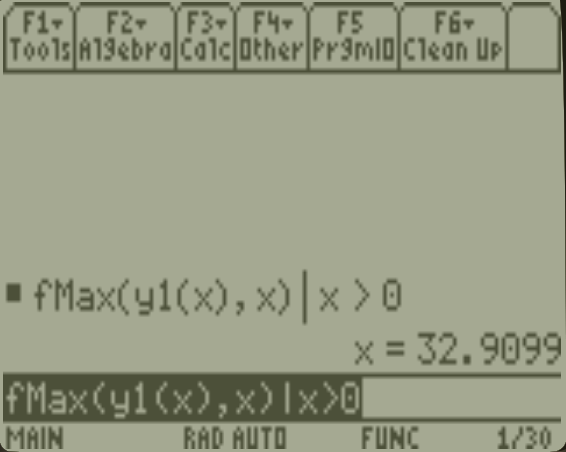
Problem 3. The total cost \(C(x)\), in dollars, of producing \(x\) items is given by \[C(x)=0.01x^3-0.6x^2+13x.\] What is the maximum profit if each item is sold for \(\$6\)? (Assume that everything produced is sold.)
(A) \(\$63.03\) \(\quad\quad\) (B) \(\$23.03\) \(\quad\quad\) (C) \(\$58.56\) \(\quad\quad\) (D) \(\$17.82\) \(\quad\quad\) (E) There is no maximum profit.
(A) \(\$63.03\) \(\quad\quad\) (B) \(\$23.03\) \(\quad\quad\) (C) \(\$58.56\) \(\quad\quad\) (D) \(\$17.82\) \(\quad\quad\) (E) There is no maximum profit.
Problem 4. The half-life of a radioactive substance is \(100\) years. How many years does it take until only \(15\%\) of the original amount remains?
(A) \(273.7\) \(\quad\quad\) (B) \(135.0\) \(\quad\quad\) (C) \(282.9\) \(\quad\quad\) (D) \(723.5\) \(\quad\quad\) (E) \(215.1\)
(A) \(273.7\) \(\quad\quad\) (B) \(135.0\) \(\quad\quad\) (C) \(282.9\) \(\quad\quad\) (D) \(723.5\) \(\quad\quad\) (E) \(215.1\)
Problem 5. The population of a city was \(100,000\) on January 1, 2016 and is growing at a continuous yearly growth rate of \(4.5\%\). In what year will the population reach \(200,000\)?
(A) \(2028\) \(\quad\quad\) (B) \(2031\) \(\quad\quad\) (C) \(2034\) \(\quad\quad\) (D) \(2037\) \(\quad\quad\) (E) \(2040\)
(A) \(2028\) \(\quad\quad\) (B) \(2031\) \(\quad\quad\) (C) \(2034\) \(\quad\quad\) (D) \(2037\) \(\quad\quad\) (E) \(2040\)
Problem 6. If interest is charged at a nominal rate of \(15.8\%\) compounded daily (365 days in a year), how much will \(\$10,000\) accumulate to after \(2\) years? Answer to the nearest dollar.
(A) \(\$13160\) \(\quad\quad\) (B) \(\$10009\) \(\quad\quad\) (C) \(\$13715\) \(\quad\quad\) (D) \(\$14102\) \(\quad\quad\) (E) \(\$12876\)
(A) \(\$13160\) \(\quad\quad\) (B) \(\$10009\) \(\quad\quad\) (C) \(\$13715\) \(\quad\quad\) (D) \(\$14102\) \(\quad\quad\) (E) \(\$12876\)
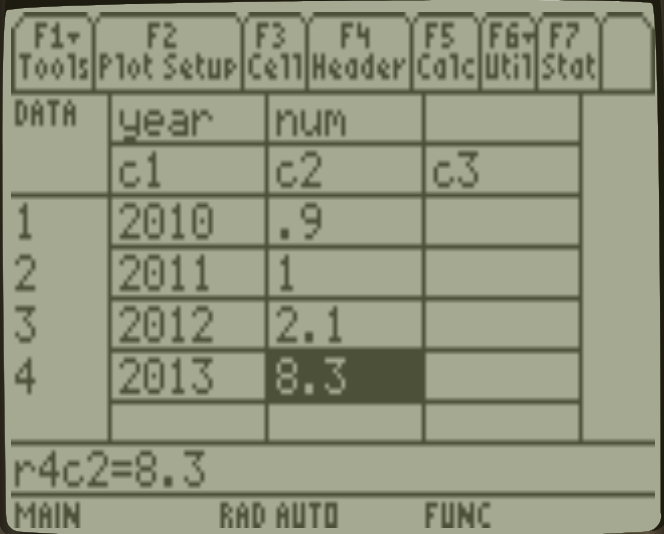
Problem 7. The table below shows the monthly text messages in billions for the years \(2010\) to \(2015\). \[\begin{array}{|c|c|}\hline
\mbox{Year}& \mbox{Monthly Text Messages (billions)}\\
\hline
2010 & 0.9\\
\hline
2011 & 1.0\\
\hline
2012 & 2.1\\
\hline
2013 & 8.3\\
\hline
2014 & 14.2\\
\hline
2015 & 28.9\\
\hline\end{array}\]
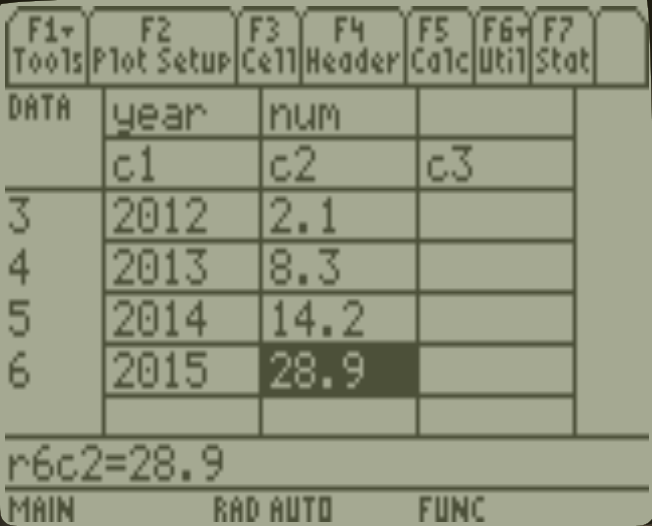
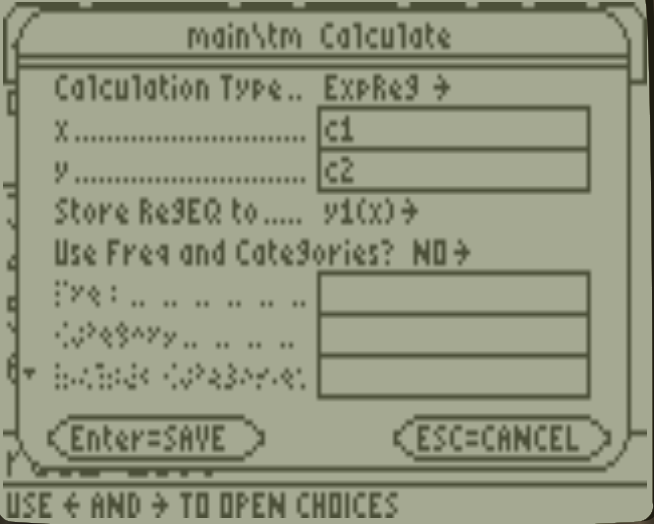
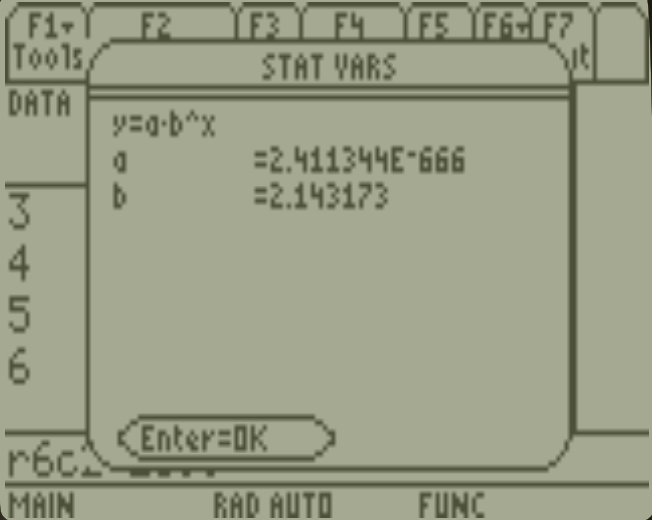
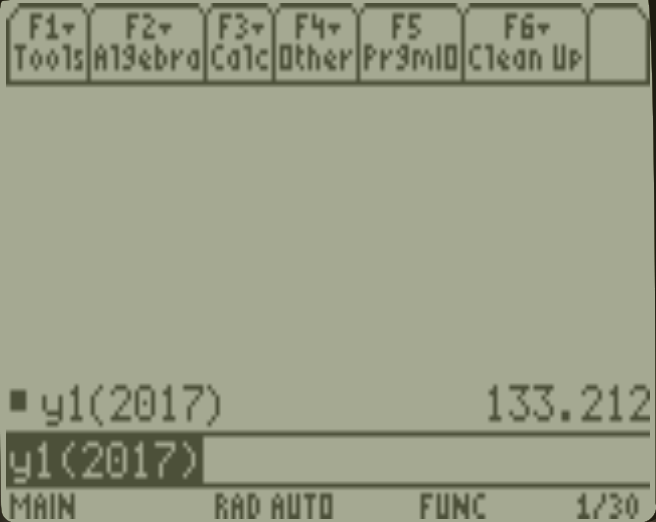
Using the year \(2010\) as the reference year (year zero), find the exponential function that best fits the data, and from that function estimate the number of text messages in \(2017\).
(A) \(33.1\) billion \(\quad\quad\) (B) \(42.4\) billion \(\quad\quad\) (C) \(127.5\) billion \(\quad\quad\) (D) \(133.2\) billion \(\quad\quad\) (E) \(141.6\) billion
(A) \(33.1\) billion \(\quad\quad\) (B) \(42.4\) billion \(\quad\quad\) (C) \(127.5\) billion \(\quad\quad\) (D) \(133.2\) billion \(\quad\quad\) (E) \(141.6\) billion
 \(\quad\quad\)
Problem 8. Given the demand curve \(p=35-x^2\) and the supply curve \(p=3+x^2\), find the producer surplus when the market is in equilibrium.
(A) \(21.4\) \(\quad\quad\) (B) \(42.7\) \(\quad\quad\) (C) \(46.4\) \(\quad\quad\) (D) \(76.1\) \(\quad\quad\) (E) \(91.1\)
(A) \(21.4\) \(\quad\quad\) (B) \(42.7\) \(\quad\quad\) (C) \(46.4\) \(\quad\quad\) (D) \(76.1\) \(\quad\quad\) (E) \(91.1\)
Problem 9. The cost function is given by \(C(x)=2x^2-3x+5\), where \(x\) is the number of items produced. For what value of \(x\) is the average cost function minimized?
(A) \(x=1.50\) \(\quad\quad\) (B) \(x=5.00\) \(\quad\quad\) (C) \(x=1.73\) \(\quad\quad\) (D) \(x=1.39\) \(\quad\quad\) (E) \(x=1.58\)
(A) \(x=1.50\) \(\quad\quad\) (B) \(x=5.00\) \(\quad\quad\) (C) \(x=1.73\) \(\quad\quad\) (D) \(x=1.39\) \(\quad\quad\) (E) \(x=1.58\)
Problem 10. What is the area enclosed by the graphs of \(y=x^3-8x^2+18x-5\) and \(y=x+5\), shown
below?
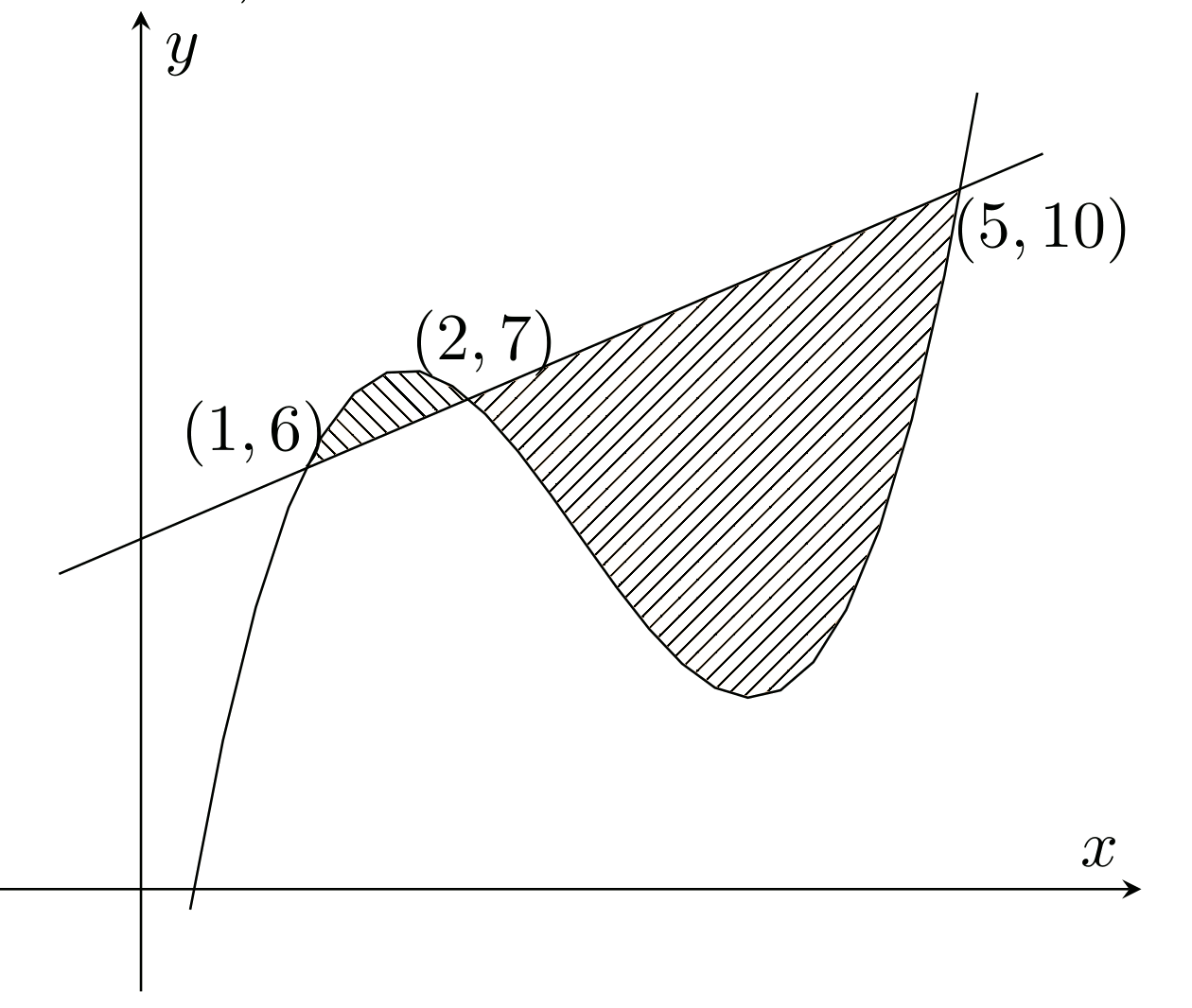
The curves intersect at \((1,6)\), \((2,7)\), and \((5,10)\).
(A) \(10.667\) \(\quad\quad\) (B) \(11.833\) \(\quad\quad\) (C) \(14.583\) \(\quad\quad\) (D) \(21.333\) \(\quad\quad\) (E) \(32\)
(A) \(10.667\) \(\quad\quad\) (B) \(11.833\) \(\quad\quad\) (C) \(14.583\) \(\quad\quad\) (D) \(21.333\) \(\quad\quad\) (E) \(32\)